
Fayette County Court Records After Arrest
After a Fayette County arrest, jail custody and court records split into two tracks. The custody track asks whether the person is in Fayette County Jail, whether release paperwork has arrived, and whether another agency has placed a hold. The court track asks what charges were filed, which docket number was assigned, whether bail or release conditions changed, and how each count moved through the case. The Pennsylvania UJS Case Search portal is the main public online route for court records after a jail arrest because it searches statewide docket sheets.
The Fayette County District Attorney's Office, led by District Attorney Michael A. Aubele, handles the prosecution path for county criminal cases. Booking allegations can appear before the final charging decision, so they should not be treated as the last word. Use Fayette County jail inmate records for custody and booking status, then use UJS for filed charges and court dates. Booking photos are a separate records issue covered by Fayette County jail mugshots.
Find Fayette Court Records After Arrest
UJS Case Search supports several search paths for Fayette County court records after an arrest. A docket number is the cleanest route when it is known. A participant name search is the practical route when the person was just booked and the family does not yet have paperwork. The portal can also use an offense tracking number, police incident or complaint number, state ID number, or organization name. Pennsylvania courts state that individual court case information and docket sheets are available online for free, but public docket sheets are not the same as a full criminal-history background check.
| Search path | Use | Fayette County note |
|---|---|---|
| Case number | Direct docket lookup | Common Pleas criminal dockets often use CP-26-CR formatting. |
| Participant name | Defendant name search | Spelling, middle initials, and date clues help avoid wrong matches. |
| Offense Tracking Number | Links arrest and prosecution records | Use the OTN when it appears on charging papers. |
| Police incident or complaint number | Complaint-based search | Useful when police paperwork lists that number. |
| State ID number | Identity-based search | Use only when the state identifier is known. |
Open the docket sheet and read each count by statute, grade, filing date, and current status. Then check the event list for preliminary arraignment, preliminary hearing, formal arraignment, motions, plea, trial, sentencing, or dismissal. If the docket has not appeared yet, the case may still be in the early booking or magisterial district stage.
Fayette County UJS Case Records
The statewide portal shown in the UJS Case Search source capture is the public tool used for Fayette County criminal docket sheets after an arrest.
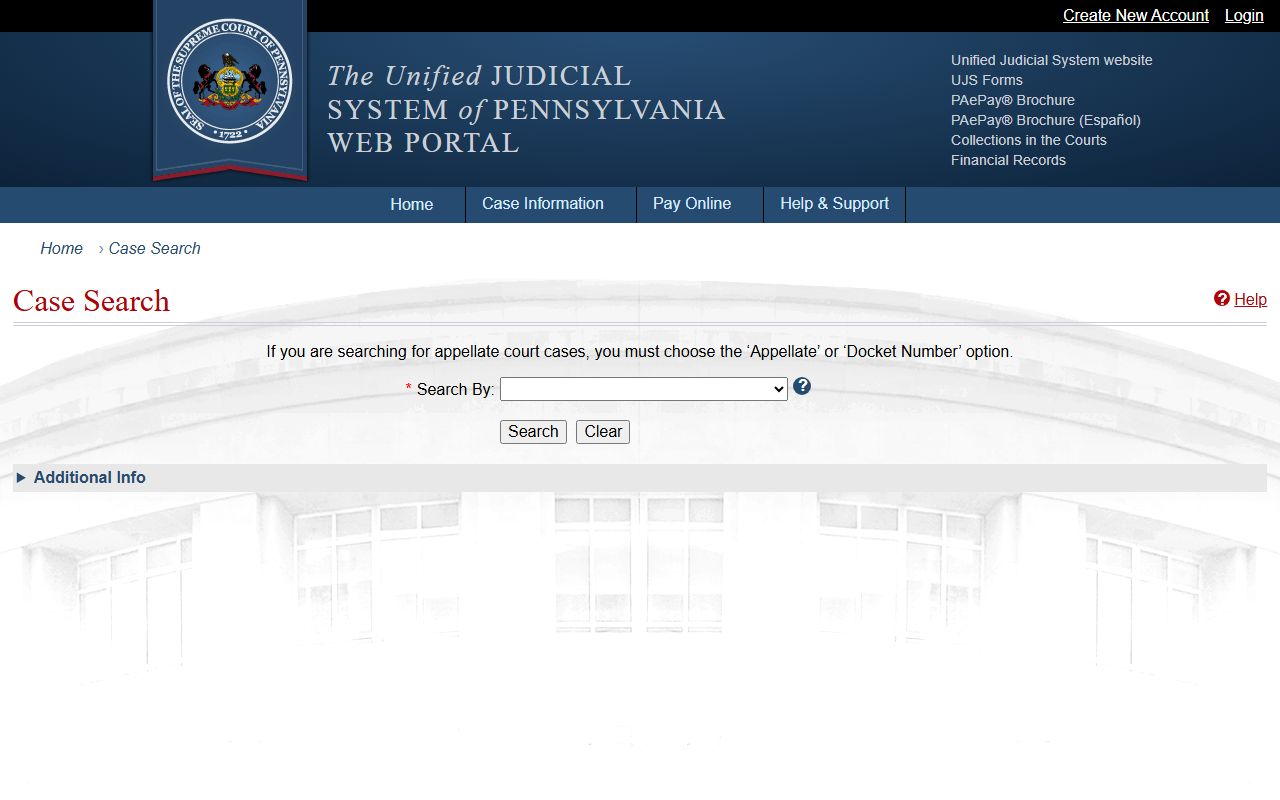
The image matters because Fayette County court records after a jail arrest are searched through the state court system, not through a separate county mugshot or booking-photo page.
Fayette Arrest Charging Records
The arrest-to-court path often starts with a complaint at the magisterial district level. If the case moves forward, felony and misdemeanor matters may proceed into the Fayette County Court of Common Pleas. The prosecutor can file or amend formal charges as the case develops. That is why a jail booking entry and a court docket can look different. The jail entry is tied to intake and custody, while the court record is tied to prosecution.
| Document | What it does | Where it fits |
|---|---|---|
| Complaint | Begins a criminal case with alleged facts and charges. | Often appears early at the magisterial district stage. |
| Information | Prosecutor-filed charging document for Common Pleas prosecution. | Common in felony and misdemeanor cases that move forward. |
| Indictment | Formal charge returned through a grand-jury process. | Less common locally, but part of the charging vocabulary. |
These document names do not prove guilt. They describe how accusations enter the court record. A charge can be filed, changed, reduced, withdrawn, dismissed, or resolved by plea or trial. The docket sheet is the best place to see the live court status.
Fayette Court Charge Status
Charge status is one of the main reasons to search court records after a Fayette County jail arrest. A person may be booked on an allegation, released on conditions, and later see the filed charges changed by the prosecutor or court. Do not assume that the first booking label is the final charge. The UJS docket should be checked for the current count list and disposition.
| Status | Meaning | Practical reading |
|---|---|---|
| Pending | The charge remains active. | Check the next hearing date and bail terms. |
| Amended or reduced | The count or grading changed. | Compare the current docket to the first filing. |
| Withdrawn or dismissed | The charge no longer proceeds in that form. | Other counts or cases may still remain. |
| Nolle prosequi | The prosecution declines to pursue that count. | Read the docket notes and any related order. |
| Guilty, acquitted, or sentenced | The case reached a disposition. | Review sentence, supervision, and custody transfer details. |
Fayette Arrest Bond Records
Bond and release conditions are set through the court, not by a website roster. Fayette County research did not locate a local bail schedule or jail payment instruction page in the inspected materials. The sound path is to read the UJS docket, contact the issuing court or defense lawyer for payment rules, and call Fayette County Jail if the question is whether release paperwork has reached the facility. Fayette County also uses non-jail options such as Pre-Trial Services, Probation with Restrictive Conditions, treatment courts, electronic monitoring, and institutional parole review.
| Release type | Meaning | Fayette County record clue |
|---|---|---|
| ROR | Release on a promise to appear. | May appear as recognizance or nonmonetary release. |
| Monetary bail | Money must be posted as the court directs. | Confirm method with the court before paying. |
| Surety bond | A surety or bond company secures release. | The county plan references bail bond companies as a normal channel. |
| Restrictive conditions | Release with supervision, treatment, no-contact terms, or monitoring. | Fayette County reports local restrictive-condition and monitoring programs. |
| Detainer or hold | Another agency or case blocks release. | Check jail, court, probation, parole, federal, or ICE channels. |
Note: A posted bond does not always mean quick release if another warrant, detainer, or court order remains active.
Fayette Arrest Warrants and Records
Fayette County warrants have a strong local source. The Sheriff's Office maintains a Fayette County Bench Warrant List page that links to criminal bench-warrant and domestic-relations warrant PDFs. The criminal warrant PDF fields visible in research were name, docket number, address, and date of birth. It did not show mugshots, bond amounts, warrant issue dates, charge descriptions, or a warrant-status field in the header.
A bench warrant can lead to a jail booking, but the warrant list alone does not confirm current custody. Search the PDF by last name or docket number, then search UJS by the docket number to find the underlying court case. Call the Sheriff's Office for sheriff-side warrant questions and call Fayette County Jail only to confirm whether the person has already been booked after warrant service.
Charges and Convictions Compared
Fayette County court records after an arrest can show accusations long before the case has a final result. A charge means the state has made an allegation through a court process. A conviction means the charge was resolved by a guilty plea, guilty verdict, or other conviction event. Public readers should keep that distinction clear when reading a docket sheet.
| Point | Charge | Conviction |
|---|---|---|
| Stage | Filed accusation. | Final or resolved finding of guilt. |
| Proof level | Case can proceed on legal charging standards. | Requires plea or proof beyond a reasonable doubt. |
| Record use | Shows pending or past allegations. | Shows court outcome and sentence if imposed. |
| Custody effect | May affect bail, holds, and hearings. | May trigger jail sentence, probation, or DOC transfer. |
Sealed and Expunged Fayette Records
Pennsylvania access rules matter when a Fayette County arrest does not end in a conviction or when a court later limits access. The Pennsylvania Right-to-Know Law creates a general public-records process, but it has exemptions. The Criminal History Record Information Act governs criminal-history information and dissemination rules. Court docket access also has its own judiciary rules.
| Record action | Plain meaning | Public search effect |
|---|---|---|
| Sealed | Hidden from ordinary public view by law or court order. | Some agencies may retain limited access. |
| Expunged | Removed or treated as no longer publicly available under the order. | Public docket and criminal-history access may change. |
| Dismissed | A charge was ended without conviction. | Check whether a separate sealing or expungement order exists. |
| Juvenile or restricted matter | Special access limits can apply. | Do not expect the same public docket access as adult cases. |
Fayette Court Record Limits
UJS docket sheets are useful, but Pennsylvania courts warn that docket sheets are not criminal-history background checks. Formal background checks use separate channels such as Pennsylvania PATCH. Records can also lag behind court activity, especially soon after arrest, during transfer from magisterial district court to Common Pleas, or when an order changes public access. Victims who need notice can use Pennsylvania VINE and the DA Victim/Witness channel.
Important: Court and jail records may not be used for credit, housing, employment, insurance, or other FCRA-covered decisions.